phpMyAdmin is the web tool in your control panel for looking inside a MySQL database: browsing tables, editing rows, running SQL and importing or exporting .sql files. This guide shows how to open it on Domain India cPanel, DirectAdmin and Webuzo hosting, how to do the everyday jobs safely, and which jobs belong in the control panel instead.
In cPanel, open Databases › phpMyAdmin; it opens already signed in and shows every database on your account. In DirectAdmin and Webuzo, open phpMyAdmin from the panel's database section. Use it to browse, search, edit, export and import. Create databases and database users, and change their passwords, in the panel's database page, not in phpMyAdmin. Always export a copy before you change or delete anything.
1. What phpMyAdmin is for
Your website's content, users, orders and settings live in a database. phpMyAdmin lets you work on that database from the browser, with no software to install.
| Job | Where to do it |
|---|---|
| Create a database or a database user | Your control panel's database page (cPanel Manage My Databases or Database Wizard) |
| Change a database user's password or privileges | Your control panel's database page |
| Browse, search and edit rows | phpMyAdmin |
| Run an SQL query | phpMyAdmin, SQL tab |
| Export (back up) or import a database | phpMyAdmin, Export and Import tabs |
| Check or repair a table | phpMyAdmin, or cPanel Manage My Databases |
On shared hosting your database user has rights over your own databases only, so phpMyAdmin cannot create new databases or users. That is by design, not a fault. To set up a database and user, follow how to connect to the MySQL database.
2. Open phpMyAdmin
In cPanel
- Sign in to cPanel.The quickest route is the client area: open your hosting services and click the cPanel button on your domain's row. It signs you in with no cPanel password. Other routes are in how to log in to cPanel.
- Find the Databases sectionon the cPanel home page, or type "phpMyAdmin" in the search box at the top.
- Click phpMyAdmin.It opens in a new tab, already signed in, with every database on your account listed on the left.
In DirectAdmin and Webuzo
Open phpMyAdmin from the panel's database section (in DirectAdmin, use the phpMyAdmin button under Account Manager › Databases). If phpMyAdmin asks you to sign in, use a database user and its password, not your panel login. Menu names change between panel versions, so if you can't find it, use the panel's search box or ask support. Panel-specific guides: phpMyAdmin in DirectAdmin and phpMyAdmin in Webuzo.
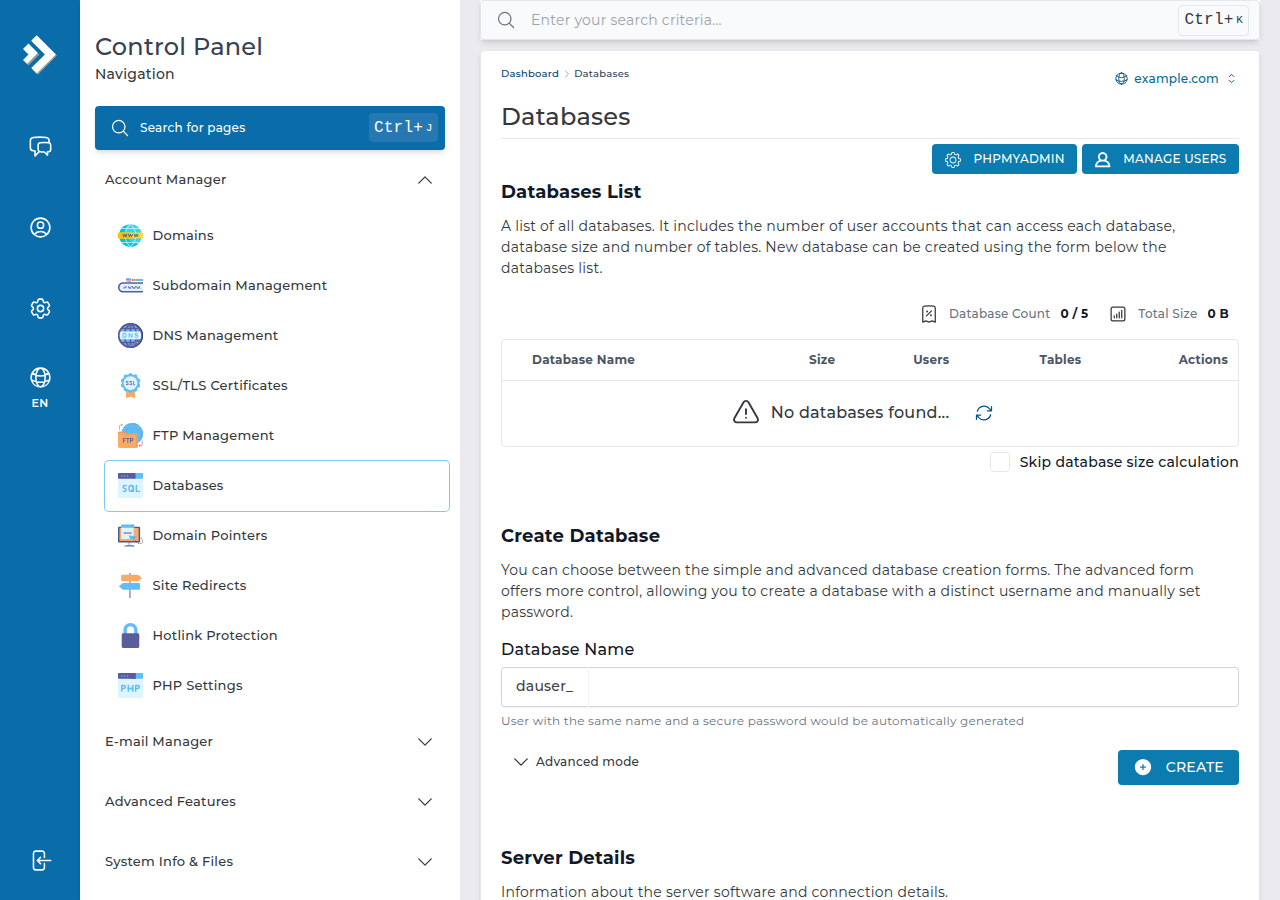
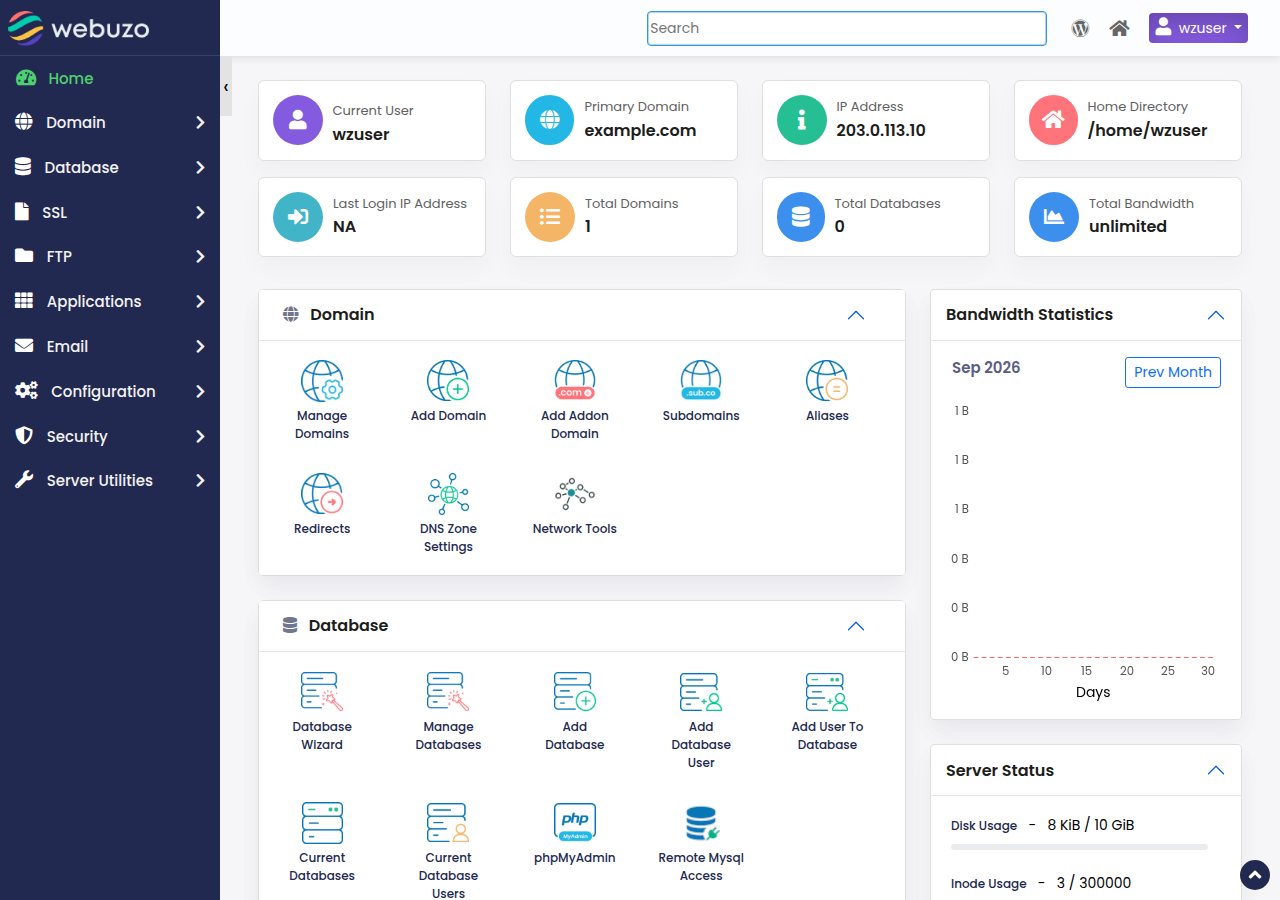
Database names carry your account username as a prefix, for example acme_wp. If you have several sites, open the site's config file to see which one it uses: for WordPress, DB_NAME in wp-config.php.
3. Find your way around
Once a database is selected on the left, phpMyAdmin shows its tables and a row of tabs across the top.
.sql file..sql file into the selected database.The home page, before you pick a database, has a Database server panel that shows the exact MariaDB or MySQL version on your server. Check it before you import a dump made elsewhere.
4. Browse, search and edit data
- Browse: click a table name. Rows appear 25 at a time; change the number or sort by clicking a column heading.
- Edit one row: click Edit on the row, change the value and click Go. Use this for small fixes, such as correcting a WordPress
siteurlor a customer's email. - Search: open the table's Search tab, type a value next to a column and pick an operator such as
LIKE %...%. - Delete rows: tick the rows and choose Delete. There is no undo.
Many plugin and theme settings are stored as serialized data, which records the length of each text value. Changing such a value by hand, or with a plain SQL REPLACE, can break the setting silently. For site-wide changes such as a domain change, use a search-and-replace tool that understands serialized data, as explained in moving a WordPress site to a new URL.
5. Run SQL queries safely
Select the database, open the SQL tab, type your query and click Go. Start with a read-only query to see what you are about to change:
-- Look before you change anything
SELECT option_name, option_value
FROM wp_options
WHERE option_name IN ('siteurl', 'home');
Then make the change, limited by a WHERE clause:
UPDATE wp_options
SET option_value = 'https://www.example.in'
WHERE option_name IN ('siteurl', 'home');
Good habits:
- Export first. One click on Export gives you a way back.
- Never run
UPDATEorDELETEwithoutWHERE, unless you really mean every row. - Check the table prefix. WordPress tables may start with something other than
wp_; use the names you see on the left. - Test big changes on a copy. Export the database, import it into a second, empty database and try the query there first.
6. Export and import
Export (back up)
Select the database, open Export, keep Quick and the SQL format, and click Export. For a large database choose Custom and set compression to gzipped, which makes the file much smaller. Keep the file on your own computer as well as on the server. Full walk-through: how to back up a MySQL database using phpMyAdmin.
Import
- Select the target databaseon the left. Import into an empty database, or you will get "table already exists" errors.
- Open Importand choose your
.sql,.sql.gzor.zipfile. - Check the size limitprinted next to the file chooser. On our cPanel servers it was 50 MB when we checked on 23 September 2026; a compressed dump usually fits.
- Click Importand wait for the green success message. Don't close the tab while it runs.
If the import stops with an error such as #1044, #1227 or "Unknown collation", database troubleshooting explains each fix. For a file that is still too large, you can import from the command line over SSH: jailed SSH access is available on every shared hosting plan (cPanel, DirectAdmin, Webuzo). It is off by default; ask support to enable it for your account.
7. Check, repair and optimise tables
If a site reports that a table "is marked as crashed", tick that table in the table list and choose Repair table from the With selected menu. Check table reports problems without changing anything, and Optimize table reclaims space after large deletions. In cPanel the same checks are on the Manage My Databases page under Modify Databases. Export first, and if a repair fails, open a ticket rather than retrying. More in database troubleshooting.
8. Working from your own computer instead
Desktop tools such as MySQL Workbench, DBeaver or HeidiSQL cannot reach your database directly: port 3306 is closed to outside connections on our shared servers, and adding your IP under Remote Database Access does not open the firewall. Once jailed SSH is enabled on your account, an SSH tunnel works; you log in with an SSH key, not a password. See securing MySQL access with SSH tunnels and enabling and accessing jailed SSH.
9. Where Domain India fits
phpMyAdmin is included on every Domain India cPanel, DirectAdmin and Webuzo plan. Starter plans include 5 MySQL databases, the middle plans (Growth, or Developer on Webuzo) include 10, and the higher plans 50. Prices on the cards are live and exclude 18% GST.
- 25 GB NVMe SSD Storage
- 50 GB Monthly Bandwidth
- 1 Website
- 10 Email Accounts
- 10 GB NVMe SSD Storage
- 50 GB Monthly Bandwidth
- 1 Website
- 5 Email Accounts
If you need a database server you control fully, including remote connections, a VPS gives you root access. Stuck? Support is on 24/7 live chat, and tickets get a first response within 15 minutes; how long a fix takes depends on the problem. There is no phone support.
Frequently asked questions
How do I open phpMyAdmin in cPanel?
Sign in to cPanel, for example with the cPanel button on your hosting service in the Domain India client area, then click phpMyAdmin in the Databases section. It opens already signed in and lists every database on your account.
Why can't I create a database inside phpMyAdmin?
On shared hosting, databases and database users are created in the control panel, for example cPanel's Manage My Databases or Database Wizard. Your database user can manage only your own databases, so phpMyAdmin has no create-database option.
phpMyAdmin asks for a username and password. Which ones?
Use a database user and that user's password, as created in your control panel's database page. Your control panel password and your client-area password will not work there.
How big a file can I import in phpMyAdmin?
The limit is printed on phpMyAdmin's Import page. On Domain India's cPanel servers it was 50 MB when checked on 23 September 2026. Compress the dump as .sql.gz to fit more; for larger files, ask support.
How do I see which MySQL or MariaDB version my server runs?
Open phpMyAdmin and look at the Database server panel on its home page. The Server version line shows the exact MariaDB or MySQL version on your server.
Can I connect to my database from MySQL Workbench instead?
Not directly, because port 3306 is closed to outside connections on Domain India shared servers. Use an SSH tunnel once jailed SSH is enabled on your account; it is available on every shared plan but off by default, so ask support to enable it.
Ready to work on your database? Open your hosting services to reach your control panel, read database troubleshooting if something fails, or compare cPanel hosting and DirectAdmin hosting if you need more databases.
Tell us the domain, the database name and the exact error. Never include your database password.
Open a support ticket