On Domain India's DirectAdmin hosting you choose the PHP version per domain, under Account Manager › PHP Settings in DirectAdmin. Our DirectAdmin server offers PHP 5.6, 7.2, 7.3, 7.4, 8.1, 8.2 and 8.3, so a legacy script and a current WordPress site can run side by side in one account. This page covers the DirectAdmin side and how to check the switch worked.
Our main guide, How to change your PHP version, also covers cPanel, Webuzo, choosing a version and fixing a site that breaks after a switch. This page is the short DirectAdmin version.
Open DirectAdmin from your hosting service, select the domain in the selector at the top right, open Account Manager › PHP Settings, pick a version in PHP Version and click UPDATE VERSION. If you can't find the setting, ask support and we will point you to it. Confirm the change with a one-line <?php echo PHP_VERSION; file, and don't set PHP options with php_value in .htaccess: on our servers that causes a 500 error.
1. Which PHP versions DirectAdmin offers
Measured on Domain India's DirectAdmin server in September 2026:
| PHP version | Status in 2026 | Notes on our DirectAdmin server |
|---|---|---|
| 8.3 | Supported, the safe choice for new sites | OPcache is off for this version |
| 8.2 | Security fixes only until 31 December 2026 | OPcache on |
| 8.1, 7.4, 7.3, 7.2, 5.6 | Out of support: no security fixes | Kept for legacy sites; OPcache on |
Servers are updated, so the list in your panel is always the final word. If you need PHP newer than 8.3, our cPanel hosting currently offers up to 8.5. For what OPcache does, see the PHP OPcache guide.
2. Change the PHP version in DirectAdmin
- Open DirectAdmin.In the client area, open your hosting services, select your DirectAdmin service and open the control panel from there. See how to log in to your control panel if you're not sure where.
- Select the domainyou want to change in the domain selector at the top right. Each domain in the account has its own settings.
- Open Account Manager › PHP Settings.
- Choose a versionin the PHP Version dropdown (the versions are listed in section 1) and click UPDATE VERSION.
- Check your sitestraight away, and confirm the version as described in section 3.
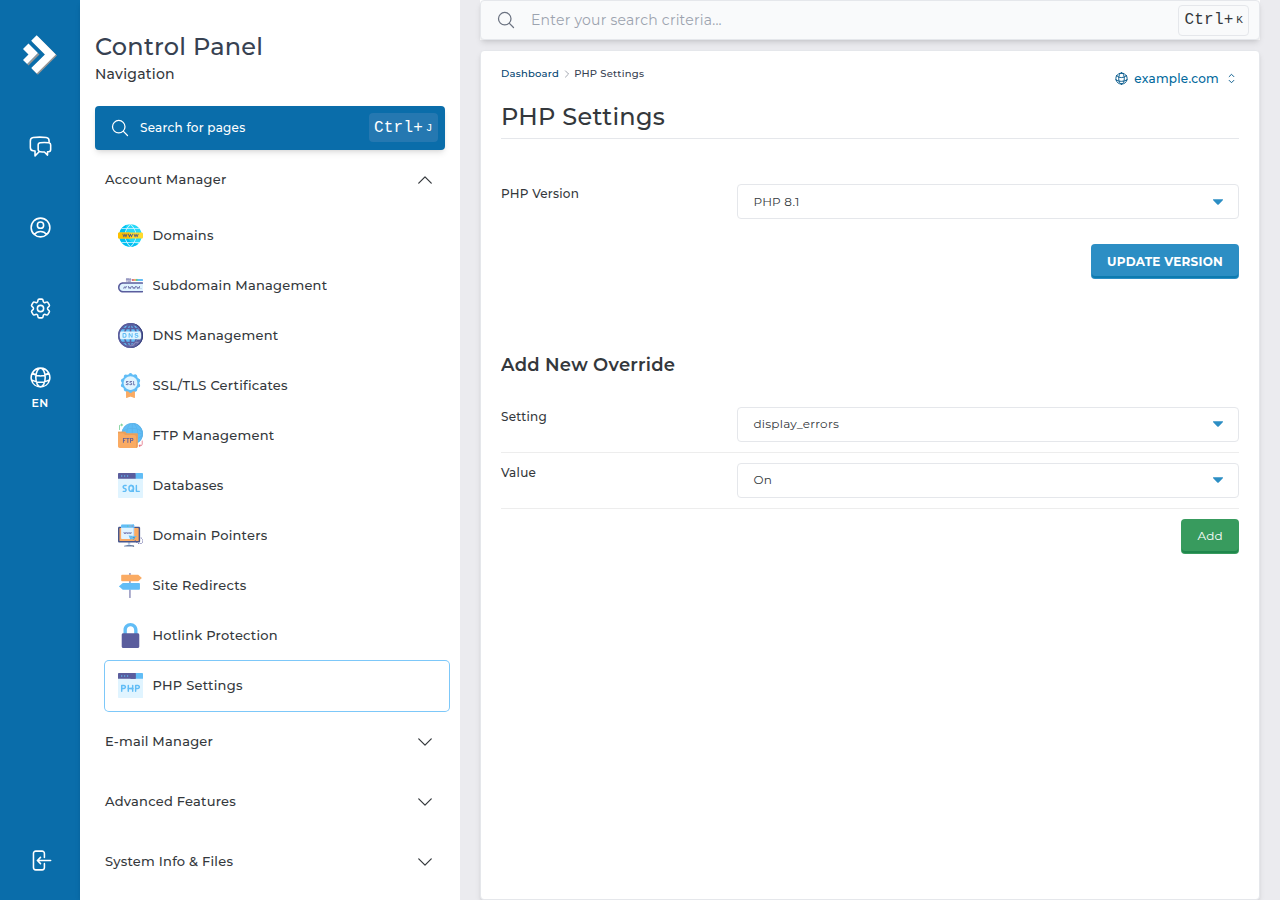
If you can't find the PHP version setting, ask support with the domain and the version you want, and we will point you to it or set it for you. Before a big jump, such as 7.4 to 8.3, update your CMS, plugins and theme, and take a copy of your files and database.
3. Check the version your site is running
Create a file with a hard-to-guess name, such as v-7f3a9.php, in the domain's public_html folder, containing one line: <?php echo PHP_VERSION;. Open it in your browser; it shows only the version number. Delete the file when you're done.
A phpinfo() page shows far more than you need and publishes your server details to anyone who finds it, so the one-line check is the safer habit. In WordPress you can also check Tools › Site Health › Info › Server.
4. PHP settings and extensions after a switch
- Settings belong to each version. A
memory_limitor upload size you raised on the old version may need setting again. Use your panel's PHP settings if your account shows them, or a.user.inifile in the site's folder with one setting per line, such asmemory_limit = 256M. See how to fix PHP memory errors and change memory_limit. - No php_value in .htaccess. Our servers run PHP through PHP-FPM or CGI, so
php_valueandphp_flaglines make the whole site return a 500 error. Older guides also suggested anAddHandlerline in.htaccessto switch versions; use the panel setting instead. - Missing extension? If your application reports one after the switch, open a ticket with the extension name and the PHP version.
- Disabled functions stay disabled whatever version you choose; see PHP disabled functions on shared hosting.
If the site breaks, switch back to the previous version first, then read the error log: see reviewing error logs in cPanel and DirectAdmin.
Frequently asked questions
How do I change the PHP version in DirectAdmin?
Open DirectAdmin from your hosting service in the client area, select the domain, open Account Manager › PHP Settings, choose a version in the PHP Version dropdown and click UPDATE VERSION. If you can't find the setting, ask Domain India support.
Which PHP versions are available on Domain India DirectAdmin hosting?
Measured in September 2026, our DirectAdmin server offers PHP 5.6, 7.2, 7.3, 7.4, 8.1, 8.2 and 8.3. PHP 8.3 is the safe choice for new sites.
Can each domain in my DirectAdmin account use a different PHP version?
Yes. The PHP version is set per domain, so each website can run the version its software needs.
Can I change the PHP version or settings with .htaccess?
No. PHP runs through PHP-FPM or CGI on our servers, so php_value and php_flag lines in .htaccess cause a 500 error. Use the panel's PHP version setting, and a .user.ini file for settings such as memory_limit.
Ready to switch? Open your hosting services to reach DirectAdmin, read the full PHP version guide, or compare DirectAdmin hosting plans.
Tell us the domain and the PHP version your application needs, and we will point you to the setting or switch it for you.
Ask our support team