Your domain name is the one part of your business that customers type, say out loud and remember. Get it right and it still works in ten years; get it wrong and you pay for it on every phone call, every business card and every search result. This guide takes you from a blank page to a registered name, including the checks that stop you buying a name you are not allowed to keep. All prices are Domain India list prices on 19 September 2026, per year, and exclude 18% GST.
A good business domain is short enough to say in one breath, spelt the way it sounds, free of hyphens and digits, and not somebody else's trademark. For a business selling in India, register the .in first (₹575 to register, ₹625 to renew) and add the .com (₹1,150 a year) if you can afford the insurance. Run three checks before you pay: the Trade Marks Registry, a plain Google search, and the social handles you will actually use.
1. Start from the business, not from the search box
Most bad domain names come from opening a search box first and taking whatever is free. Write down three things before you search:
- What customers already call you. If people say "Meera's Kitchen", the domain should contain those words, not a clever alternative you invented last night.
- Where you sell. A bakery in Chennai, a pan-India software product and an export business want different extensions. Section 5 decides that.
- How the name will be used. Painted on a van and read out over the phone? Short and phonetic wins. Tapped from an Instagram bio? Being memorable matters more than length.
Then write at least ten candidates: your name plus what you do (meeraskitchen), a place (kitchenchennai), a promise (freshbymeera), or a coined word (meerabakes). Do not judge them yet — the scoring sheet below is less sentimental than you are.
2. What actually makes a name memorable
Memorability is not mysterious. Aim for under fifteen characters before the dot and two words at most. Then run the phone test: read the name aloud to somebody who has never seen it, and ask them to write it down. If they hesitate, or if two people write two different spellings, the name will bleed traffic forever. Names with ph or f, k or c, doubled letters or a common regional spelling variant always need this test.
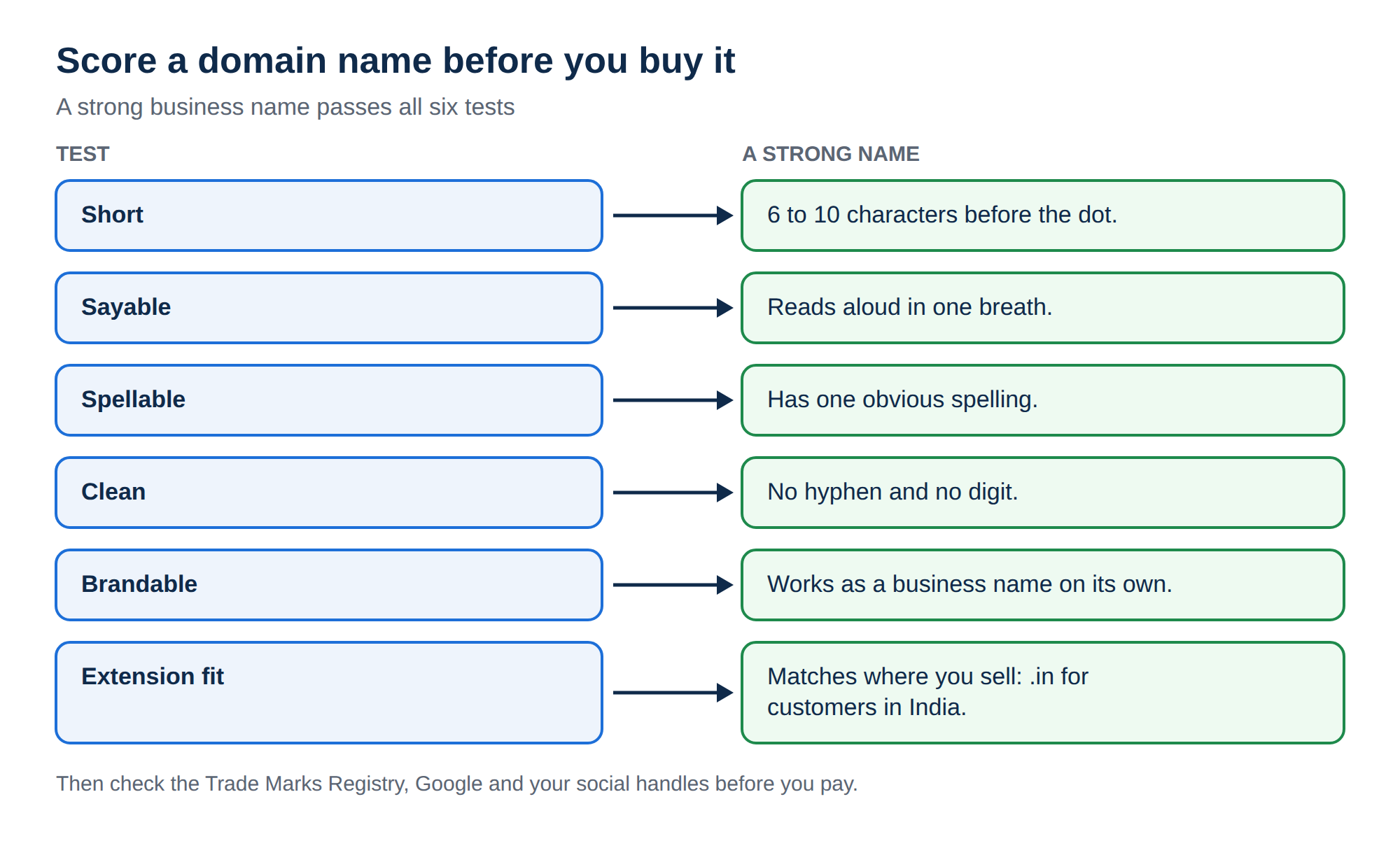
Score each candidate out of 12. Anything below 8 goes back to the brainstorm.
| Test | 2 points | 1 point | 0 points |
|---|---|---|---|
| Short | 6-10 characters before the dot | 11-15 characters | 16 or more |
| Sayable | Reads aloud in one breath | Needs one clarification | Has to be spelt out |
| Spellable | One obvious spelling | Two plausible spellings | A deliberate misspelling |
| Clean | No hyphen and no digit | One hyphen or one digit | Both, or several |
| Brandable | Works as a business name on its own | Descriptive but generic | Only makes sense with context |
| Extension fit | Matches where you sell | A relevant newer extension | Picked only because it was free |
3. Hyphens, digits and the traps that follow you around
These are the mistakes that look harmless in a search box and cost you customers for years.
One more trap: singular and plural. Register shopcake.in and customers will type shopcakes.in. Take both, or pick a name without the problem.
4. Keywords or a brand name?
The old advice was to stuff the keyword into the domain: bestcakesonlinechennai.com. That advice is out of date.
- A single-service local business that will never sell anything else
- Directory-style sites where the keyword genuinely is the product
- Making it obvious what you sell, with no explanation
- Search engines give the words in a domain very little weight on their own
- It locks you into one product and one city on the day you register it
- Long keyword strings look less trustworthy in a search result than a clean brand
- You cannot build a brand on a phrase three competitors also use
meeraskitchen.in with a page titled "Custom birthday cakes in Chennai" will out-perform bestcakesonlinechennai.com with thin pages, and it can still be your name when you open a second branch in Coimbatore. The domain is your identity; the pages carry the keywords.
5. .in, .co.in or .com — the decision that matters most in India
The extension changes what your name costs, what it costs every year after, and what a customer assumes about you before the page loads. Domain India is a NIXI-accredited .IN registrar, so the Indian family comes to you directly from us.
| Extension | Register (first year) | Renew (each year) | Best for |
|---|---|---|---|
| .in | ₹575 | ₹625 | Any business whose customers are in India |
| .co.in | ₹475 | ₹525 | Indian companies; the cheapest of the family |
| .com | ₹1,150 | ₹1,150 | Customers outside India, and the extension people type by default |
| .net.in / .org.in / .firm.in | ₹475 | ₹525 | A second Indian name at the lowest price |
| .org | ₹1,108 | ₹1,108 | Non-profits, associations and trusts |
| .net | ₹1,438 | ₹1,769 | Rarely a first choice today; take it defensively |
| .shop / .store | ₹3,775 / ₹4,708 | ₹4,259 / ₹5,285 | Online stores that want the word in the name |
| .online | ₹3,015 | ₹3,315 | Services delivered remotely |
| .tech / .io | ₹5,651 | ₹6,005 | Technology brands and software products |
| .app / .dev | ₹1,850 / ₹1,509 | ₹2,028 / ₹1,757 | Apps and developer tools; both require HTTPS by design |
| .bharat | ₹599 | ₹599 | Reaching customers in Devanagari script |
Choose .in when your customers, suppliers and payments are in India. It is the cheapest widely trusted extension and it tells a visitor immediately where you are. For a shop, a services business, a clinic, a school or a regional brand, this is the default.
Choose .co.in when you are a registered company, the .in you want is gone, or you want a second name at the lowest price in the catalogue. It is open to anyone — no company document to submit — and reads slightly more corporate, at the cost of one extra syllable.
Choose .com when you sell outside India, want the extension people type without thinking, or expect to raise money or sell the business one day. It also renews at the same price it registers for, which is not true of most newer extensions.
Choose a newer extension (.shop, .store, .tech, .io, .app) when the word is genuinely part of the brand — never merely because the .com was taken.
Year one is the smallest number you will ever pay for a domain. Budget on the renewal price multiplied by the number of years you plan to trade. Five years on .in costs ₹575 + 4 × ₹625 = ₹3,075. Five years on .tech costs ₹5,651 + 4 × ₹6,005 = ₹29,671 for exactly the same website.
6. The five checks to run before you pay
- Check both extensions at once.Search the name at Domain India domain registration. If only one of the .in and the .com is free, decide now whether you can live without the other. Short of ideas? The AI Domain Advisor suggests available names from a description of your business.
- Search the Trade Marks Registry.Use the Indian Trade Marks Registry public search for the word part of your name, in your class of goods or services.
- Check the social handles.Instagram, YouTube, Facebook, LinkedIn, X. Consistency matters more than an exact match, but if every handle is already held by an active account, the name is crowded.
- Google the name.If the first page of results is another business with the same name, customers will confuse the two of you regardless of who registered first.
- Look up who holds it, if it is taken.A WHOIS lookup shows whether the name sits on a parked page or behind a real business. A parked name may be for sale; buying and selling domains covers how an acquisition works.
Checks 2, 3 and 4 take about twenty minutes together, and skipping them is the most expensive shortcut in this article.
7. Trademarks: the names you are not allowed to keep
Registering a domain gives you the right to use that name for as long as you renew it. It does not give you the words in it, and it does not beat somebody else's registered trademark. If your domain copies a registered mark in the same line of business, the owner can take it from you — through the .IN Dispute Resolution Policy for Indian extensions, or the UDRP for global ones — long after you have printed the stationery and built the search ranking. The dispute does not care that you registered first.
Anything containing a bank, a film title, a phone brand or a well-known company name. Anything one letter away from a large competitor. And anything a trademark search shows as registered by somebody else in your class of goods or services. A domain you cannot defend is a liability with a renewal invoice attached.
The related question — protecting your own name — is answered in Can I copyright my domain name?. The short version: register a trademark for the brand, and keep the domain renewed.
8. Which variants to buy, and which to skip
You do not need thirty spellings. You need the ones a customer might type by mistake and the ones a competitor might buy on purpose.
Beyond that, buy a misspelling only when your name has one obvious wrong spelling that real people produce — the phone test from section 2 will tell you. Otherwise the money is better spent on an extra year of renewal. Point every extra domain at your main website: a defensive domain showing an error page is worse than not owning it, because visitors assume your business is broken.
WHOIS privacy is worth a word. For .in and its second-level extensions (.co.in, .net.in, .org.in and others), personal registrant details are not shown in public WHOIS. This is free and automatic; there is nothing to switch on. On .com, .net, .org and most global extensions it is an optional add-on at ₹300 a year per domain, replacing your personal contact details in the public record with a forwarding address. Registry rules on published contact details differ by extension, so check what applies to the one you pick.
9. Registering it properly with Domain India
The name is only as safe as the way you register it.
- Register it in the business's name.The registrant should be the company or the proprietor, with an email address that will still be read in five years. A domain held in a freelancer's or a former employee's personal account is one of the commonest ownership disputes our support desk sees.
- Register for two or three years.The per-year price is the same, and it removes the commonest way businesses lose a name: a renewal email nobody opened. Ten years is the maximum on every extension we sell.
- Finish the .IN verification immediately.Indian extensions require the registrant email to be verified and a one-time eKYC to be completed, and until both are done the registry can put the name on hold. Understanding KYC requirements for domain registration walks through it.
- Point the name somewhere the same day.Even a one-page "coming soon" site tells customers and search engines the name is live. The AI Website Builder puts one up in minutes; how to change your domain DNS settings covers pointing the name at hosting you already have.
- Know how renewal works.Domain India never charges a saved card on its own. A renewal invoice is generated and emailed up to 30 days before the due date, and the name renews when that invoice is paid. If you no longer want it, decline the renewal in the client area or leave the invoice unpaid — no penalty either way.
One thing to know before you click Register: a domain registration is not refundable once the name is created with the registry. To withdraw an order before it is processed, see I want to cancel my domain name order. For the whole buying process end to end — searching, ordering, verification, DNS — read the ultimate guide to domain name registration.
Frequently asked questions
Should an Indian business choose .in or .com?
Choose .in first if your customers are in India. It costs ₹575 to register and ₹625 a year to renew, against ₹1,150 a year for .com, and it signals a local business. Add the .com when you sell outside India, or to stop anyone else using your name on the extension most people type by default. Prices are Domain India list prices on 19 September 2026 and exclude 18% GST.
Does putting a keyword in my domain help my Google ranking?
Very little on its own. Search engines rank pages on content, relevance and the links pointing at them, not on the words in the domain. A short brand name with strong pages beats a long keyword domain with thin ones.
How many years should I register a business domain for?
Two or three years for your main name. The price per year is the same as registering for one, and the longer term removes the risk of losing the name to a missed renewal email. The maximum is ten years on every extension Domain India sells.
Can I change my domain name later?
You can register a new one and redirect the old one, but printed material, directory listings, links from other sites and customer bookmarks keep pointing at the old name. Treat the choice as close to permanent, and keep the old domain renewed and redirecting for at least a year after any change.
What should I do if the name I want is already registered?
Check the .co.in or another extension, add a short descriptive word (meerabakes.in rather than meera.in), or use a WHOIS lookup to see whether the holder is trading. A parked name may be for sale; an active business with the same name is a reason to choose differently.
Does Domain India charge my card automatically when a domain is due?
No. A renewal invoice is generated and emailed up to 30 days before the due date, and the domain renews only when that invoice is paid. You can decline a renewal in the client area at no penalty, or leave the invoice unpaid if you no longer want the name.
Is a domain registration refundable?
No. Once the name is created with the registry in your name it cannot be returned, so the fee for a registered domain is non-refundable. That is why the checks in this article matter: a trademark search costs ten minutes, and a name you have to abandon costs a rebrand.
Ready to register the name?
If the name has passed the scoring sheet, the trademark search and the handle check, check both extensions side by side at domain registration, or let the AI Domain Advisor suggest available names from a description of your business. If the name you want is taken, buying and selling domains explains your options, and our team is on live chat and tickets around the clock if you want a second opinion before you commit.
Search once and see the Indian and global extensions together, register for up to ten years, and get it from a NIXI-accredited .IN registrar.
Search and register your domain