Many business owners ask whether they can copyright their domain name so that nobody else can use it. The short answer is no, but your name is not unprotected. This guide explains, in general terms for India, what protects a name instead and how to keep your brand and domain safe.
You cannot copyright a domain name. Copyright protects creative works such as text, images and code, not short names or phrases. A name is protected by trademark registration with the Trade Marks Registry (IP India) and by the law of passing off, and Indian courts have treated domain names as protectable in the same way as trademarks. Registering a domain only gives you the right to use that address while you keep renewing it. Your website's content, on the other hand, is protected by copyright.
This article explains the general position in India so you can ask the right questions. It is not legal advice. For a decision about your brand, a trademark filing or a dispute, speak to a qualified intellectual-property lawyer.
1. Why a domain name cannot be copyrighted
Copyright, under India's Copyright Act, 1957, protects original creative works: literary works (articles, blog posts, software code), artistic works (logos as artwork, graphics, photographs), music, films and sound recordings. It protects the way an idea is expressed, not the idea or the words themselves.
A domain name, such as mybrand.in, is a short name. Short names, titles, slogans and single words do not carry enough creative expression to be copyright works, in India or in most other countries, so there is no copyright to register in a domain name.
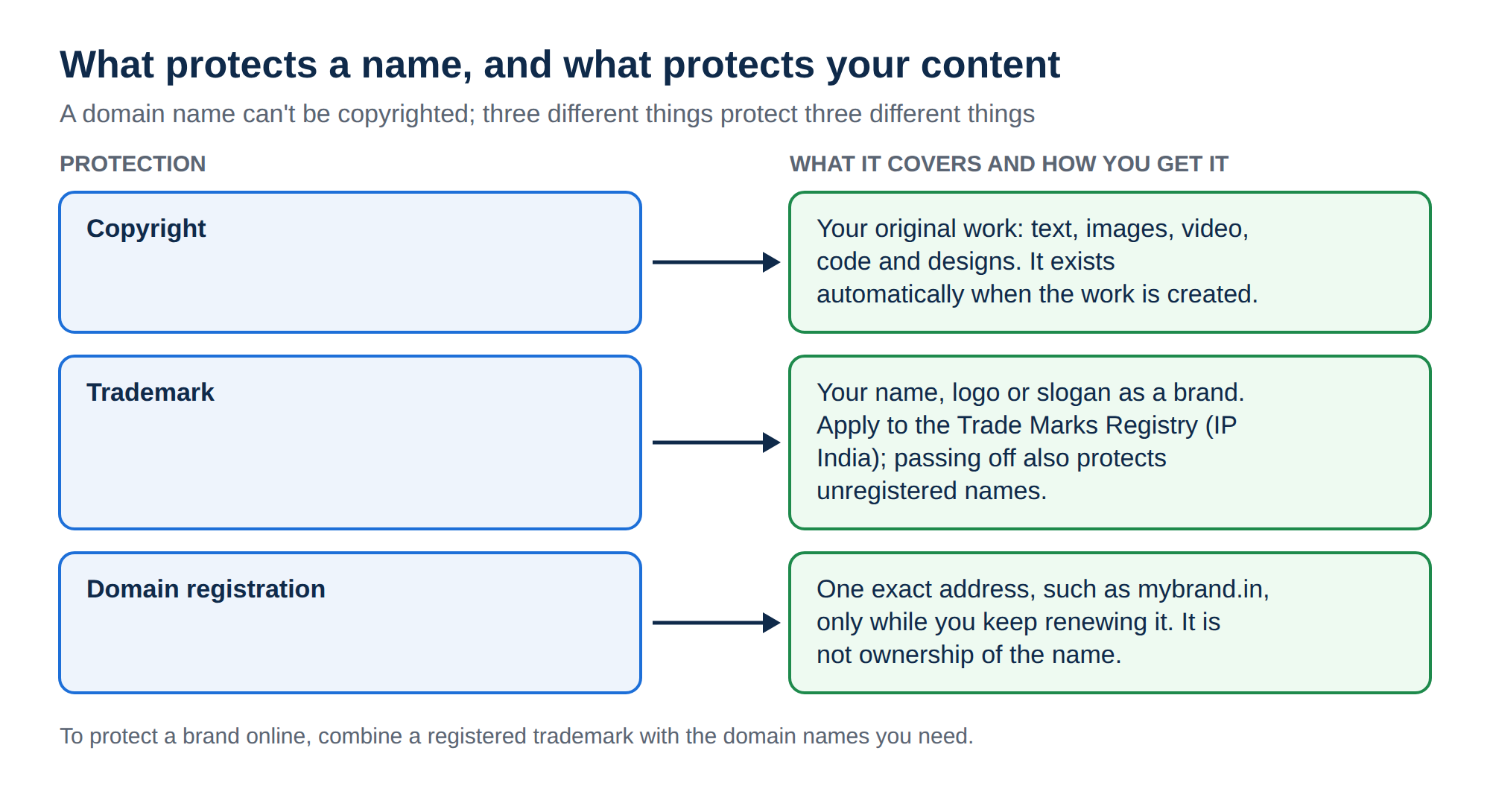
The three kinds of protection that people often confuse work very differently:
| Protection | What it covers | How you get it | What it stops |
|---|---|---|---|
| Copyright | Original creative work: text, images, video, code, designs | Exists automatically when the work is created; registration is optional | Others copying your work |
| Trademark | A name, logo or slogan used to identify your goods or services | Apply to the Trade Marks Registry (IP India); unregistered marks can be protected through passing off | Others using a confusingly similar name for related goods or services |
| Domain registration | One exact internet address, such as mybrand.in | Register it with a domain registrar and keep renewing it | Only that exact address being registered by someone else while yours is active |
2. What registering a domain actually gives you
When you register a domain, you get the right to use that exact address for the period you paid for, usually 1 to 10 years at a time, and to keep it as long as you renew it before it expires. It is closer to a renewable licence than to ownership of the word.
In practice:
- It does not stop similar names. Owning
mybrand.indoes not stop someone registeringmybrand.com,my-brand.inormybrandindia.in. - It does not give you rights in the word. A domain registration on its own is not a trademark. If your name copies someone else's registered brand, your domain can be taken from you in a dispute, however long you have held it.
- It lasts only while you renew. If the domain expires and is released, anyone can register it. Renewals matter as much as the original registration.
For the full basics of choosing and registering a domain, read The ultimate guide to domain name registration.
3. Trademark: the protection that fits a name
A trademark is a name, word, logo, slogan or other sign that identifies your goods or services and distinguishes them from other traders'. In India, trademarks are governed by the Trade Marks Act, 1999, and registered by the Trade Marks Registry, part of the Office of the Controller General of Patents, Designs and Trade Marks, on the IP India website.
A registered trademark gives you the exclusive right to use the mark for the classes of goods or services it is registered in, and a much stronger position if someone copies it, including in a domain name. In general:
- You register it in classes. Trademarks are filed for specific classes of goods and services, so a mark for software is not automatically protected for restaurants.
- Distinctive names are easier to protect. An invented or unusual name is far easier to register and enforce than a descriptive one such as "Best Hosting India".
- A registration lasts 10 years and can be renewed every 10 years, in principle indefinitely.
- The ® symbol is only for registered marks. You can use "TM" with a name you claim as your mark; use ® only after registration.
Trademark filing fees change and depend on the type of applicant, so check the current official fees on the IP India website before you file. Search the public trademark records there first, too: it tells you whether someone already has a similar mark.
4. Passing off and domain names in Indian courts
You do not need a registered trademark to have any protection. Under the law of passing off, a business that has built up goodwill in a name can stop another trader from using a confusingly similar name to pass off their business as yours. It is harder to prove than infringement of a registered mark, because you must show your reputation and likely confusion.
Indian courts apply these principles to domain names. In Satyam Infoway Ltd v Sifynet Solutions Pvt Ltd (2004), the Supreme Court of India held that a domain name is more than an internet address: it can identify a business and its services, and so can be protected like a trademark, including through a passing-off action. So Indian trademark owners can go to court over a copycat domain, as well as using the dispute policies in section 7.
Treat your business name as a brand to be protected by trademark, and your domain as one of the places that brand appears. A registered trademark is what gives you a strong claim against a copycat domain.
5. What copyright does protect: your website content
Copyright protects the original content on your website:
- the text you write, such as articles, product descriptions and blog posts;
- your photographs, graphics, illustrations and videos;
- your logo as a piece of artwork (the logo as a brand is protected by trademark);
- the code and design you or your developer created.
In India, copyright arises automatically when the work is created; you do not have to register it. Registration with the Copyright Office is optional, but a registration certificate is useful evidence if you ever have to prove the work is yours.
If you use a web designer or developer, agree in writing who owns the copyright in the design and code. Without an agreement, the person who created the work may own it. Keep your original files, and add a copyright notice to your site's footer.
6. How to protect your brand online
- Check before you choose.Search the trademark records on the IP India website and check that the domain is free. Avoid any name close to an existing brand.
- Register your trademark.File for your business name, and your logo if it matters, in the classes you trade in. A lawyer or trademark agent can help with the search and filing.
- Register the key domains.Take your main extension, usually .in for an Indian business, plus .com, and common misspellings or hyphenated versions if your brand is well known. Point the extras at your main website.
- Keep renewals on.An expired domain can be registered by anyone, including a competitor. Keep your contact email current so renewal notices reach you, and renew early.
- Keep the transfer lock on.The registrar lock stops your domain being transferred to another registrar without your say. Switch it off only when you are moving the domain yourself.
- Secure your account.Use a strong, unique password and two-factor authentication on your registrar account, because anyone who can log in can unlock or move your domain.
- Watch for look-alikes.Now and then, search for domains that imitate your name, and act early if one appears.
Read Understanding domain lock for how the lock works in your client area.
7. When someone else has registered your name
If someone else has registered a domain that copies your brand, the right route depends on the extension, the evidence and what you want.
- INDRP (the .IN Domain Name Dispute Resolution Policy) is run by NIXI, the .IN registry, and covers .in domains, including .co.in and the other .in extensions. A trademark owner can file a complaint, which is decided by an arbitrator.
- UDRP (the Uniform Domain-Name Dispute-Resolution Policy) is ICANN's policy for .com and most other generic extensions. Complaints are decided by approved providers such as WIPO. See ICANN's UDRP page.
- Court action for trademark infringement or passing off is also possible in India, and a court can grant remedies that the dispute policies cannot, such as an injunction or damages.
Under both INDRP and UDRP, the complainant generally has to show three things: that the domain is identical or confusingly similar to their trademark, that the holder has no legitimate right or interest in it, and that it was registered or is being used in bad faith. The usual remedy is transfer or cancellation of the domain.
Talk to an intellectual-property lawyer before you file a complaint, send a legal notice, or reply to one you have received. Do the same before paying anyone who offers to "sell back" a copycat domain: how you respond can affect your case.
The same rules work the other way: a domain that copies someone else's trademark can be taken from you. Read more in Domain dispute resolution, Domain squatting and cybersquatting and the trademark section of Mastering domains: acquisition, selling and beyond.
8. Where Domain India fits
Domain India is a NIXI-accredited .IN registrar, so you can register .in, .co.in and the other Indian extensions directly with us, alongside .com and hundreds of other extensions. We do not register trademarks or give legal advice, but we handle the domain side: registering the extensions you need, the transfer lock and renewals, in one account. The transfer lock is free on every domain.
| Extension | Register (1 year) | Renew (per year) | Good for |
|---|---|---|---|
| .in | ₹575 | ₹625 | Your main address if you serve India |
| .co.in | ₹475 | ₹525 | A second Indian address for a company |
| .com | ₹1,150 | ₹1,150 | Global reach, and to stop others taking it |
Domain India list prices on 19 September 2026, excluding 18% GST. Registering your name in .in, .co.in and .com together costs ₹2,200 in the first year.
Frequently asked questions
Can I copyright my domain name in India?
No. Copyright protects original creative works such as text, images, videos and code. A domain name is a short name, and short names and phrases are not protected by copyright. A name is protected through trademark registration and the law of passing off.
Does registering a domain make me the owner of that name?
No. Registering a domain gives you the right to use that exact address for as long as you keep renewing it. It does not give you rights in the word itself, and it does not stop others registering similar domains or other extensions.
How do I legally protect my business name online in India?
Register the name as a trademark with the Trade Marks Registry through the IP India website, in the classes of goods or services you trade in. Then register the key domains, such as .in and .com, keep them renewed and keep the transfer lock on.
Can a domain name be protected like a trademark in India?
Yes. In Satyam Infoway Ltd v Sifynet Solutions Pvt Ltd (2004), the Supreme Court of India held that a domain name can serve as a business identifier and can be protected like a trademark, including through a passing-off action.
What can I do if someone registers a domain with my brand name?
For a .in domain you can file a complaint under INDRP, run by NIXI; for .com and most other generic extensions you can use the UDRP. You may also be able to go to court for trademark infringement or passing off. Speak to an intellectual-property lawyer before you act.
Is my website content protected by copyright?
Yes. Original text, photographs, graphics, videos and code on your website are protected by copyright automatically when they are created. Registration with the Copyright Office is optional but gives useful evidence of ownership.
How much does it cost to register a trademark in India?
Official filing fees change and depend on the type of applicant, so check the current fees on the IP India website. If you use a lawyer or trademark agent, their professional fees are extra.
Ready to secure your name? Search for your .in, .co.in and .com on domain registration, and read The ultimate guide to domain name registration for the next steps.
Check your name in .in, .co.in and .com, and keep every domain in one Domain India account.
Search for a domain