Domain India's DirectAdmin shared servers run CloudLinux, which gives every account its own fixed share of the server. That is why a busy neighbour cannot slow your site down, and why your own site is held to its share even when the server looks quiet.
The limits themselves are explained in Understanding hosting resource limits. If visitors are seeing "Resource Limit Is Reached" right now, go to Addressing "Resource Limit Reached" issues with DirectAdmin hosting.
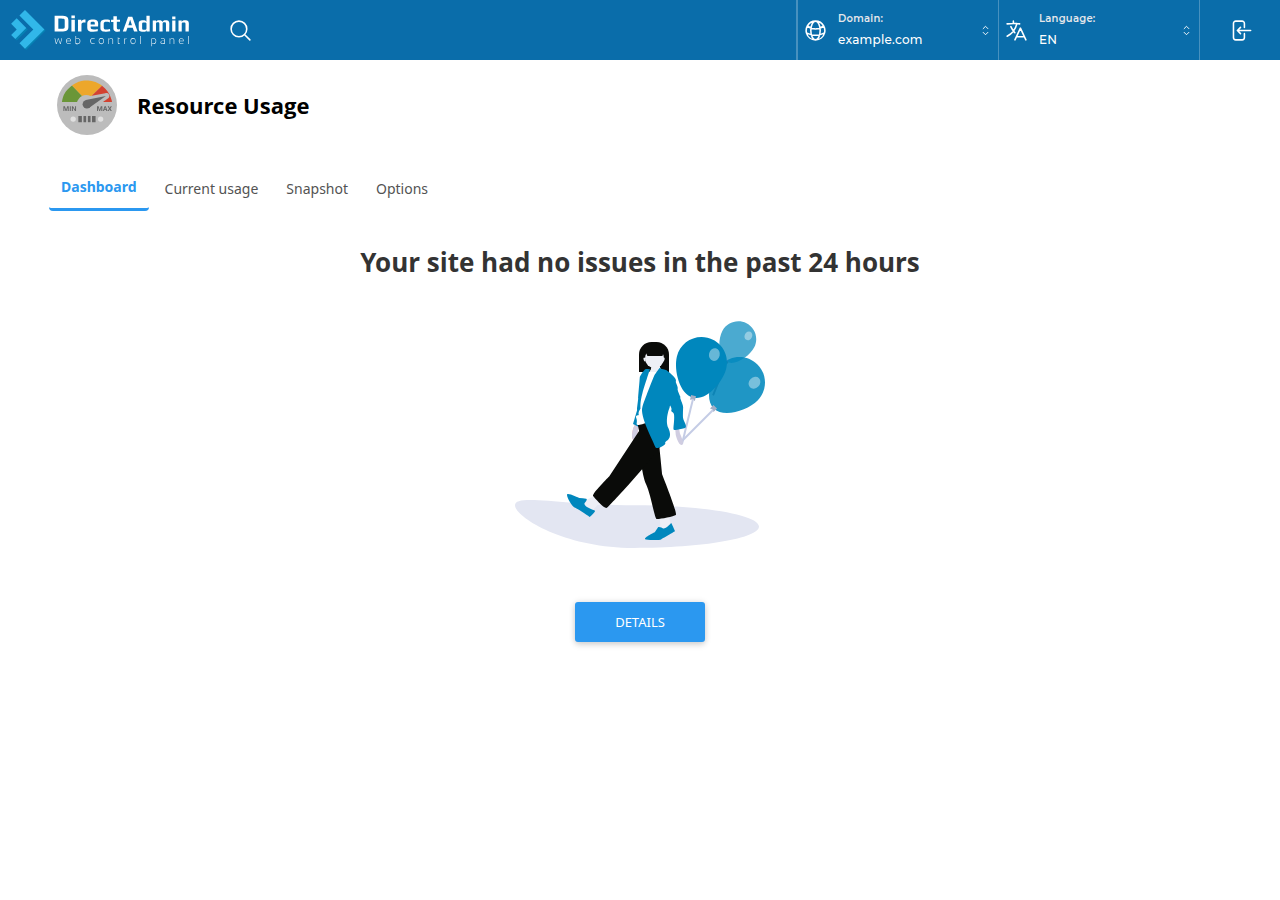
CloudLinux puts each account in its own Lightweight Virtual Environment (LVE), with limits for CPU, physical memory, entry processes, number of processes, I/O and IOPS. Hitting CPU or I/O slows the site down; running out of entry processes shows visitors a 508 "Resource Limit Is Reached" page; memory and process limits cause 500 or 503 errors. A fault is one moment your account hit a limit. Your usage and faults are on the Resource Usage page in DirectAdmin: type it in the Search for pages box at the top of the DirectAdmin menu, or press Ctrl+J. If you need help reading it, open a ticket and we will read your usage and faults for you.
1. The limits, and what each one feels like
Our DirectAdmin servers run CloudLinux (measured on our servers, 20 September 2026), the same as our cPanel servers, and each account sits in its own LVE with fixed limits.
| Limit | What it measures | What happens when you hit it |
|---|---|---|
| CPU | Processor time used by your scripts and cron jobs | The site slows down but still loads |
| Physical memory | RAM used by all your processes together | A process is stopped; visitors may see a 500 or 503 error |
| Entry processes | PHP requests running at the same moment | New requests get a "Resource Limit Is Reached" (508) page |
| Number of processes | Everything running under your account, including cron | New processes can't start; 500 or 503 errors, failed cron jobs |
| I/O and IOPS | How fast, and how often, your account uses the disk | Imports, backups and busy databases drag |
Two points people get wrong. Entry processes are not visitors: an entry process is one web request running PHP at that moment, so a cached page doesn't take one, while a page waiting on a slow payment or SMS service holds its slot the whole time. And the account memory limit is not PHP's memory_limit, which applies to a single script: see How to fix "Allowed memory size exhausted" PHP errors. Disk space and inodes are separate storage limits, but they fail just as hard when full.
2. Checking your usage
Log in with the DirectAdmin button on your hosting row in the client area; it signs you in with no password. The CloudLinux usage page is called Resource Usage: type it in the Search for pages box at the top of the DirectAdmin menu, or press Ctrl+J. The walkthrough is in How to check resource usage in DirectAdmin.
Open a ticket at /support/ticket with your domain and the date and time of the problem, and we will tell you which resource faulted, when, and what it points to.
Command-line tools such as lveinfo are server administrator tools and are not available inside a hosting account, so there is nothing to run over SSH.
3. What causes faults, and what fixes them
A few faults during a traffic spike are normal; faults every day need fixing. CPU and I/O faults point at heavy plugins, slow queries and uncached pages; entry-process faults at bot floods, login attacks and slow outside calls; memory faults at imports and image processing. The fixes, in full, are in the DirectAdmin "Resource Limit Reached" guide.
- Cache your pages.Our shared hosting runs Apache, so on WordPress use WP Super Cache or W3 Total Cache, with one caching plugin only. A cached page doesn't run PHP, so it never takes an entry-process slot.
- Block abusive bots in
.htaccess.mod_rewriteis loaded on our DirectAdmin servers. Never block Googlebot or Bingbot. - Move heavy jobs to quiet hours,and run WordPress's scheduled tasks from a real cron job instead of on page visits.
- Put a timeout of a few seconds on every outside call.If faults pile up while CPU and memory stay low, this is usually the cause, and a bigger plan will not fix it.
A php_value or php_flag line gives a 500 error on our servers, which run PHP through PHP-FPM or CGI, and it does not change your CloudLinux limits either. An Options line on DirectAdmin may use only Indexes, IncludesNOEXEC, MultiViews, SymLinksIfOwnerMatch, FollowSymLinks or None; any other value also gives a 500.
4. When to upgrade
Upgrade when faults continue after you have fixed the causes, or when genuine traffic has grown. An active cPanel or DirectAdmin plan can be upgraded at any time: open Hosting › My hosting, select your hosting service and choose Change plan. You pay only the difference for the time left until your renewal date, plus 18% GST, and the new limits apply as soon as that invoice is paid.
- 30 GB NVMe SSD Storage
- Unmetered Bandwidth
- 5 Websites
- 50 Email Accounts
The price on the card is live and excludes 18% GST. A VPS has no shared-hosting limits: dedicated vCPU and RAM, tuned by you.
Does Domain India DirectAdmin hosting use CloudLinux?
Yes. Our DirectAdmin shared servers run CloudLinux, measured on 20 September 2026. Each account has its own Lightweight Virtual Environment with limits for CPU, physical memory, entry processes, number of processes, I/O and IOPS.
What is an entry process on DirectAdmin hosting?
An entry process is one web request running PHP at that moment. Cached pages, images and stylesheets do not use one. When all your account's entry processes are busy, new requests get a 508 "Resource Limit Is Reached" page until some finish. A bigger plan helps only if the requests are genuinely working rather than waiting.
How do I see my CloudLinux usage in DirectAdmin?
Open the Resource Usage page: type Resource Usage in the Search for pages box at the top of the DirectAdmin menu, or press Ctrl+J. If you need help reading it, open a support ticket with your domain and the time of the problem and we will read your usage and faults for you.
Can I run lveinfo over SSH to see my limits?
No. lveinfo is a server administrator tool and does not run from inside a hosting account. Ask support for your account's current limits, usage and faults instead.
Ready to check your account? Read your usage with How to check resource usage in DirectAdmin, or open a ticket with your domain and the time of the problem.
Tell us your domain and when the problem happened, and we will read your DirectAdmin account's usage and faults with you.
Open a support ticket