WHOIS privacy hides a domain owner's personal contact details (name, address, email and phone number) from the public WHOIS record, so anyone who looks up the domain sees that it is registered but not who you are or how to reach you. At Domain India, how you get it depends on the extension: it is free and automatic on .in domains, and an optional add-on on .com and most other extensions.
Step-by-step instructions, the status labels in the client area and how to remove privacy are in how to enable or disable privacy protection for your domain name.
For .in and its second-level extensions (.co.in, .net.in, .org.in and others), personal registrant details are not shown in public WHOIS. This is free and automatic; there is nothing to switch on. For .com, .net, .org and most other extensions, WHOIS privacy is an optional add-on at ₹300 a year per domain (excluding 18% GST), which you enable from the domain's page in the client area. There is no self-service switch to turn it off; ask support.
1. What WHOIS is and why privacy matters
WHOIS (now also served through a newer protocol called RDAP) is the public directory of who holds each domain. Registrars must collect accurate contact details for every domain they register. Without privacy, some or all of those details can appear in a public lookup, where they are harvested for spam, sales calls and phishing attempts.
WHOIS privacy replaces your personal details in the public record with generic or proxy details. Some things always stay public on every extension: the domain name, the registrar, the creation and expiry dates, the nameservers and the status codes.
What privacy does not do:
- It does not let you register with false details. You must still give your registrar accurate contact information; privacy only hides it from the public.
- It does not put your details beyond the law. Registrars and registries can still disclose registrant data when the law or a legitimate complaint requires it.
2. WHOIS privacy by extension at Domain India
| Extension | WHOIS privacy | Price |
|---|---|---|
| .in, .co.in, .net.in, .org.in and the rest of the .in family | Personal details hidden automatically by the registry | Free, nothing to buy |
| .com, .net, .org and most other extensions | Optional add-on, enabled per domain | ₹300 a year per domain |
Prices are Domain India list prices on 19 September 2026, excluding 18% GST. On a .in domain, personal details are hidden; if the domain is registered to a company or organisation, that organisation's name may still appear.
Not every extension works like .com. Some registries hide personal data themselves, as the .IN registry does; some do not allow privacy services at all; and some treat individuals and organisations differently. Privacy options differ by extension, so if you are unsure about one, ask support before you buy.
3. Turning on WHOIS privacy for a .com
- Open the domain.Log in and open your domains, then click the domain.
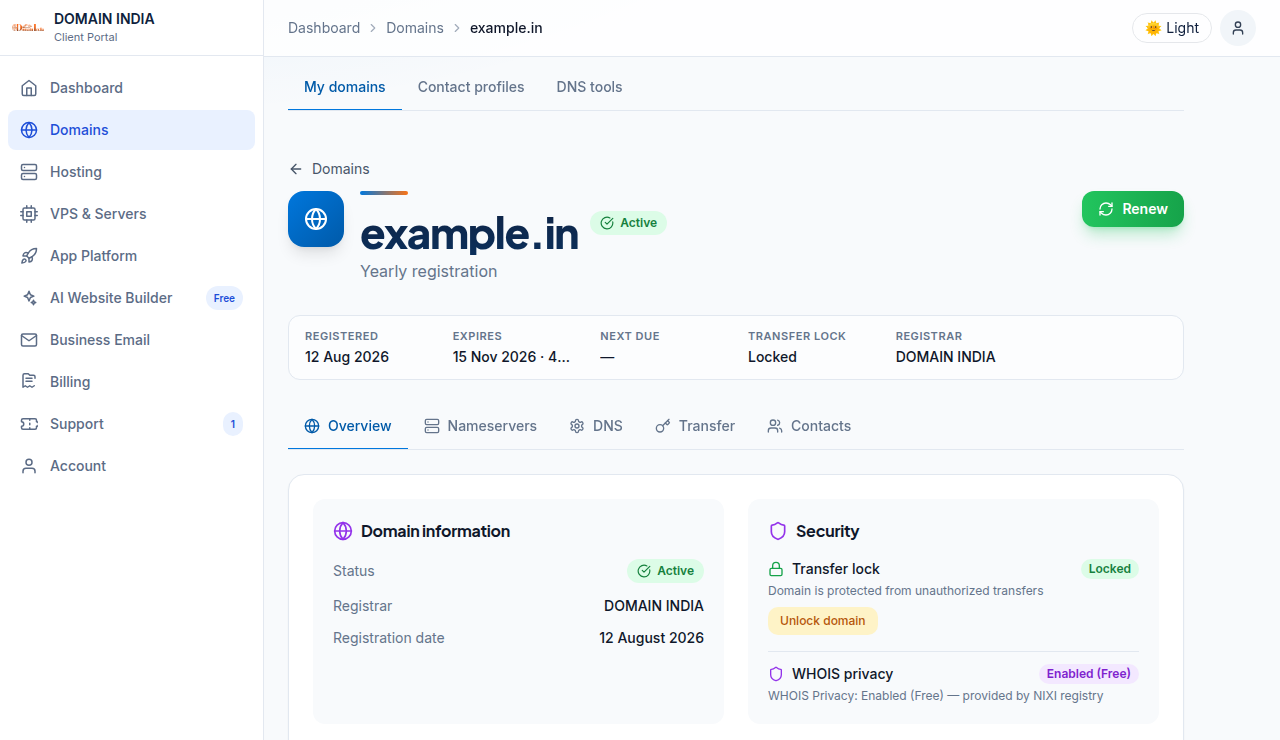
- Find the Security cardon the Overview tab. Its WHOIS privacy row shows the current status.
- Click "Enable privacy protection"if the status reads "Not enabled". The button shows the yearly price.
- Pay the invoicethat opens. Once it is paid, the row should read "Enabled". If it doesn't, open a ticket at /client/support/new with the domain name and invoice number.
To remove privacy, there is no self-service switch; open a ticket with the domain name and the reason.
4. Check what the public sees
Run your domain through the WHOIS lookup to see exactly what a stranger sees. Keep the details behind the privacy accurate too: an out-of-date email address is the most common reason people miss renewal and verification emails. See how to change your domain's WHOIS information.
What is WHOIS privacy?
WHOIS privacy hides a domain owner's personal contact details, such as name, address, email and phone number, from the public WHOIS record. The domain, registrar, dates and nameservers stay public.
Do I need WHOIS privacy for a .in domain?
No. For .in and its second-level extensions such as .co.in, personal registrant details are not shown in public WHOIS. This is free and automatic, and there is nothing to switch on.
How much is WHOIS privacy for a .com at Domain India?
₹300 a year per domain, excluding 18% GST, at Domain India list prices on 19 September 2026. It is an optional add-on enabled from the domain's page in the client area.
How do I turn WHOIS privacy off?
There is no self-service switch in the client area. Open a support ticket with the domain name and the reason, and the support team will remove it.
Can I use false details instead of WHOIS privacy?
No. Registrars must hold accurate registrant details, and false details can lead to a domain being suspended or lost in a dispute. Privacy is the correct way to keep accurate details out of public view.
Ready to protect your details? Search for a name at domain registration, check any domain with the WHOIS lookup, or manage privacy on a domain you already hold from your domains.
Search .in and .com side by side and register from a NIXI-accredited .IN registrar.
Search for your domain