If your domain has expired and you have been quoted a restoration (redemption) fee, the figure can come as a shock: several times the normal renewal price. The reason is that restoring a domain is not a renewal. Once the late-renewal window has passed, the registry treats the domain as deleted, and bringing it back is a separate process for which the registry charges the registrar. This guide explains where the fee comes from, what Domain India charges for .in and .com, and how to make sure you never pay it.
A restoration fee is high because it pays for recovering a domain the registry has already started to delete, plus the renewal itself. At Domain India, a .in domain can be renewed at the normal price up to day 36 after expiry; from day 37 it can only be restored, for ₹4,000, which includes GST and the renewal. A .com restored after its grace period costs ₹8,000, which includes GST and one year. Paying the renewal invoice before expiry avoids the fee completely.
1. Renewal and restoration are different things
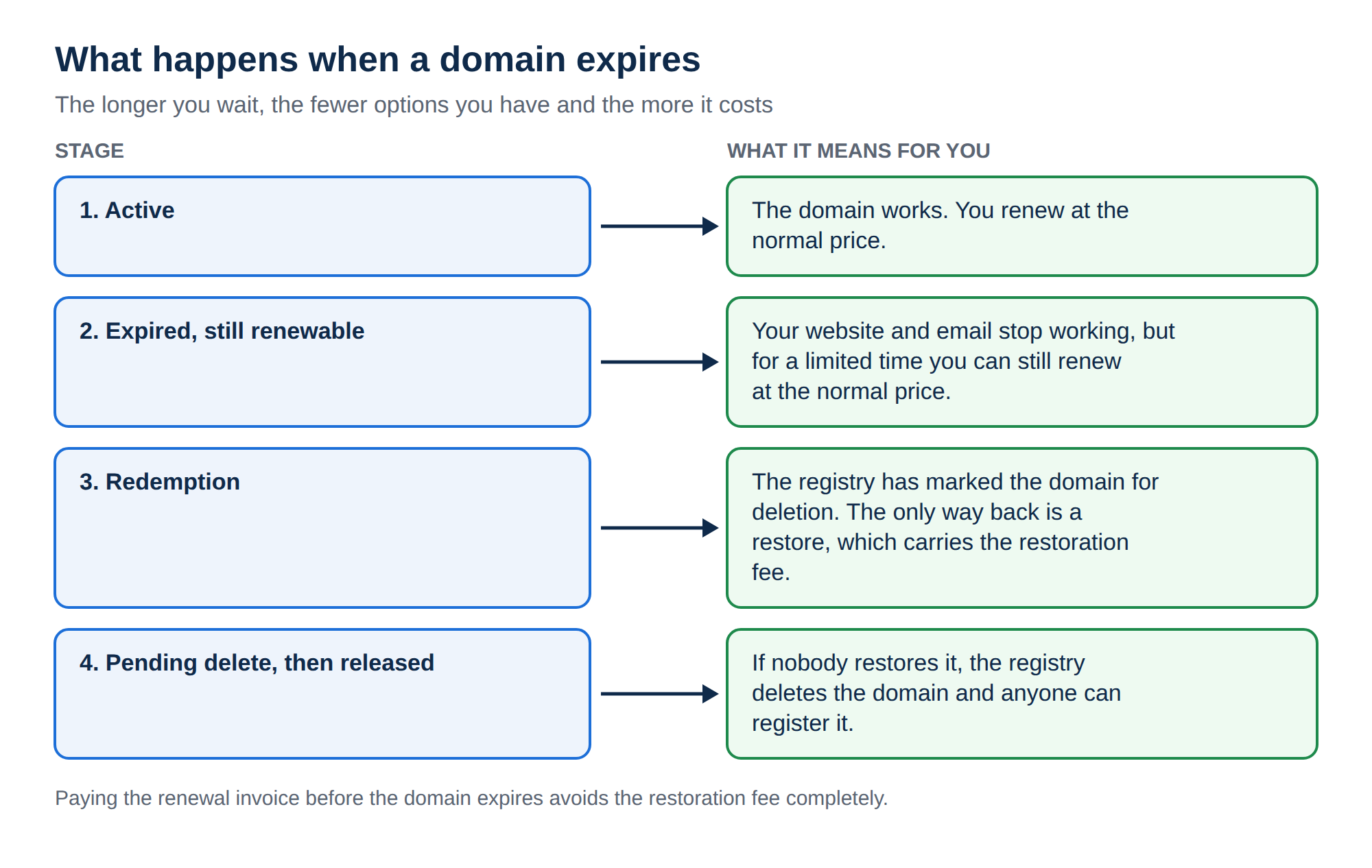
A domain moves through a few stages after its expiry date. The names and lengths of these stages vary by extension, but the pattern is the same:
- Active.The domain works. You renew at the normal price.
- Expired, still renewable.The domain stops resolving, so your website and email stop working, but you can still renew it at the normal price for a limited time.
- Redemption.The late-renewal window has closed. The registry has marked the domain for deletion, and the only way back is a restore, which carries the restoration fee.
- Pending delete, then released.If nobody restores it, the registry deletes the domain and anyone can register it.
The restoration fee applies only at stage 3. Up to that point, an expired domain costs the same to renew as an active one.
2. Why the restoration fee is so much higher
The fee isn't a penalty that Domain India invents. It is made up of costs the registrar has to pay or carry:
Because the largest part of the fee comes from the registry, a registrar can't waive it. That is why Domain India publishes fixed restoration prices rather than negotiating them case by case.
3. What Domain India charges
| Extension | Time since expiry | What you pay |
|---|---|---|
| .in family (.in, .co.in and others) | Up to day 36 | The normal renewal price |
| .in family | From day 37 | Restoration, ₹4,000 (includes GST and the renewal) |
| .com | During the grace period after expiry | The normal renewal price |
| .com | After the grace period | Restoration, ₹8,000 (includes GST and one year) |
Normal renewal prices are ₹625 a year for .in and ₹1,150 a year for .com, Domain India list prices on 19 September 2026, excluding 18% GST.
The grace period for .com and other generic extensions varies by extension, so ask support for your domain's exact dates rather than relying on a general figure. For any other extension, ask support for the restoration price before you pay.
If your domain has only just expired, it may still be in the normal renewal window. Open the domain in your client area and pay any renewal invoice today: that costs the normal price, not the restoration fee.
4. How to restore a domain that is already in redemption
If your domain is registered with Domain India and has passed the normal renewal window:
- Open a ticket straight away.Use a new ticket with the domain name, and say you want it restored. Speed matters, because the domain is deleted at the end of the redemption stage.
- Confirm the price.Support confirms whether the domain can still be restored and what it costs.
- Pay the restoration invoice.The restoration is carried out after payment.
- Check the domain.Once it is restored, it resolves again. DNS answers are cached around the internet, so some visitors may see the old result for a few hours.
If your domain is registered with another company, only that company can restore it, because only the registrar of record can send the restore to the registry. Contact them directly.
5. If the domain is deleted and released
Once a domain has passed through redemption and been deleted, it can't be restored by anyone. It becomes available again, and whoever registers it first gets it.
- Watch for the release. Search for the name on Register a domain and register it the moment it becomes available.
- Expect competition. Names with traffic or a history are often registered by others within moments of release. There is no guaranteed way to catch a deleted domain.
That uncertainty is why restoring a valuable domain, even at the restoration price, is usually cheaper than trying to win it back later.
6. How to never pay a restoration fee
Every restoration we handle traces back to a renewal invoice that wasn't paid. A few habits prevent it:
Add your own calendar reminder for your main domain, and check your domains once in a while for anything close to its expiry date. How auto-renewal works explains the invoice process in full.
7. Where Domain India fits
Domain India is a NIXI-accredited .IN registrar, so for .in domains we deal with the registry directly. Every domain you hold with us is managed from one client area, where you can see its expiry date, pay renewal invoices and switch renewal invoices on or off. If your domain has stopped working and you are not sure why, Why is my domain suspended? helps you find the cause.
Support is available on 24/7 live chat, and tickets get a first response within 15 minutes; resolution can take longer. There is no phone support.
Frequently asked questions
Why is the domain redemption fee so high?
Because it covers restoring a domain the registry has already marked for deletion. The registry charges registrars a separate restore fee for this, the restore is a separate request handled case by case, and the renewal itself is included in the price. A normal renewal before the late-renewal window closes costs far less.
How much does it cost to restore an expired .in domain at Domain India?
A .in domain can be renewed at the normal price up to day 36 after expiry. From day 37 it can only be restored, for ₹4,000, which includes GST and the renewal.
How much does it cost to restore an expired .com domain?
After the grace period, restoring a .com at Domain India costs ₹8,000, which includes GST and one year. The grace period varies by extension, so ask support for your domain's exact dates.
Can Domain India waive or reduce the restoration fee?
No. Most of the fee is the registry's restore charge, which the registrar has to pay, so it can't be waived. Paying the renewal invoice before the domain reaches redemption avoids the fee entirely.
What happens if I don't restore my domain?
The registry deletes it at the end of the redemption stage, and it is released for anyone to register. After deletion it can't be restored at any price.
My domain is registered with another company. Can Domain India restore it?
No. Only the registrar that holds the domain can restore it, so contact that company. A domain in redemption usually can't be transferred until it has been restored.
Does Domain India renew my domain automatically so this can't happen?
Domain India never charges a saved card. A renewal invoice is emailed up to 30 days before the due date, and the domain renews only when that invoice is paid, so keep your account email current and pay renewal invoices when they arrive.
Ready to protect your domain? Check expiry dates in your domains, pay any renewal in your invoices, or open a support ticket if your domain has already expired.
Tell us the domain name. We will check which stage it is in and tell you the cheapest way to get it back.
Open a ticket